Vittles Vault: A Plain Guide to Baby-Proof Dog Food Storage
Reader-supported — if you buy through our links we may earn a commission, at no extra cost to you. As an Amazon Associate I earn from qualifying purchases. Details
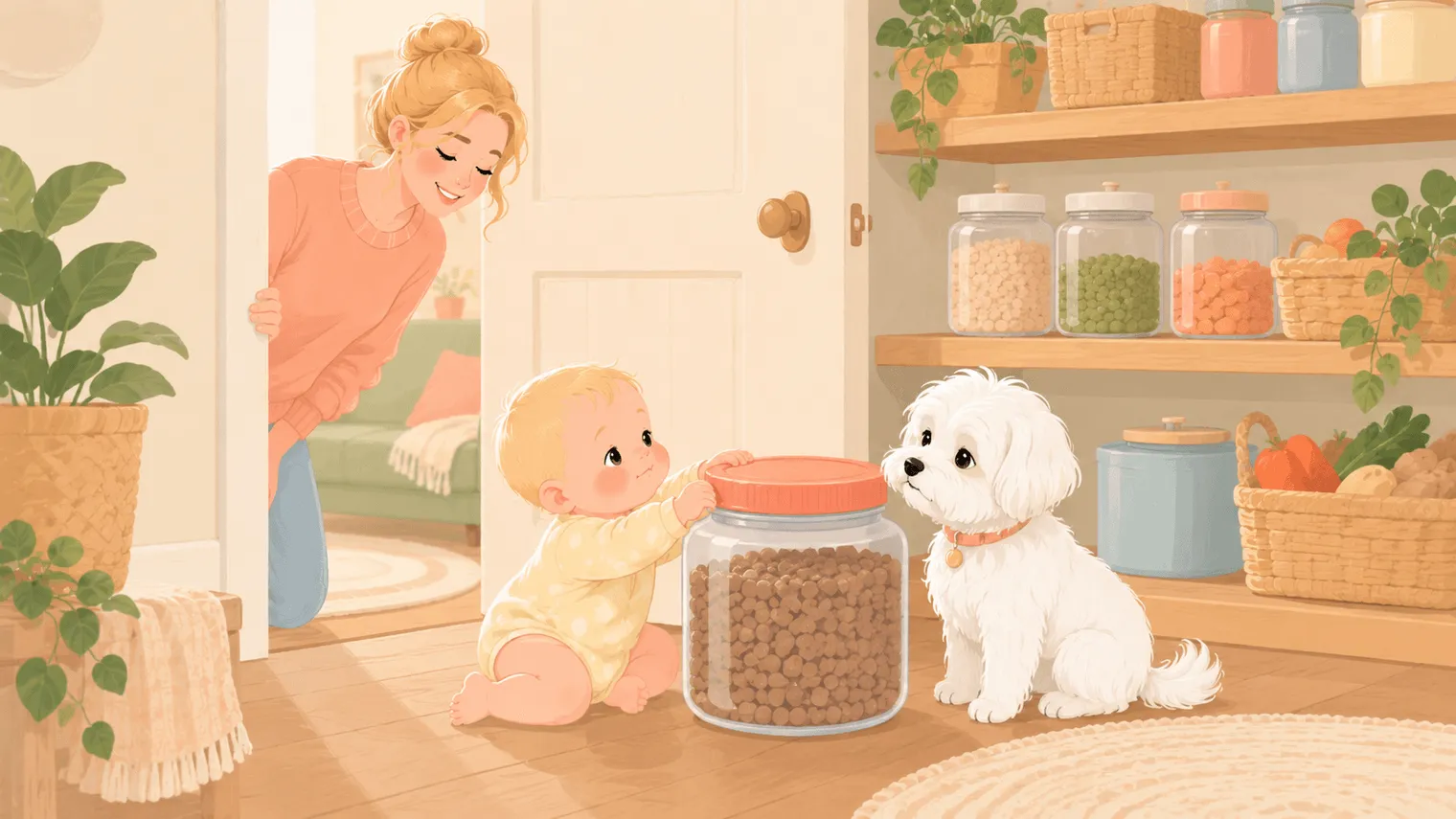
Every dog-and-baby household eventually hosts the same race: a newly mobile baby, a gravity-fed trajectory toward the dog food, and a parent doing the cross-room lunge. The Vittles Vault’s pitch is to cancel the race entirely — a container a toddler can’t open, a dog can’t crack, and oxygen can’t sneak into. If your kibble currently lives in its bag and your baby has located the pantry, this is aimed squarely at you.
We haven’t tested this ourselves — this guide is built from the spec sheet and the patterns across years of owner reviews, including an encouraging number that begin “my lab has tried everything.” Where the listing and owners disagree, we say so.
The two-species problem it solves
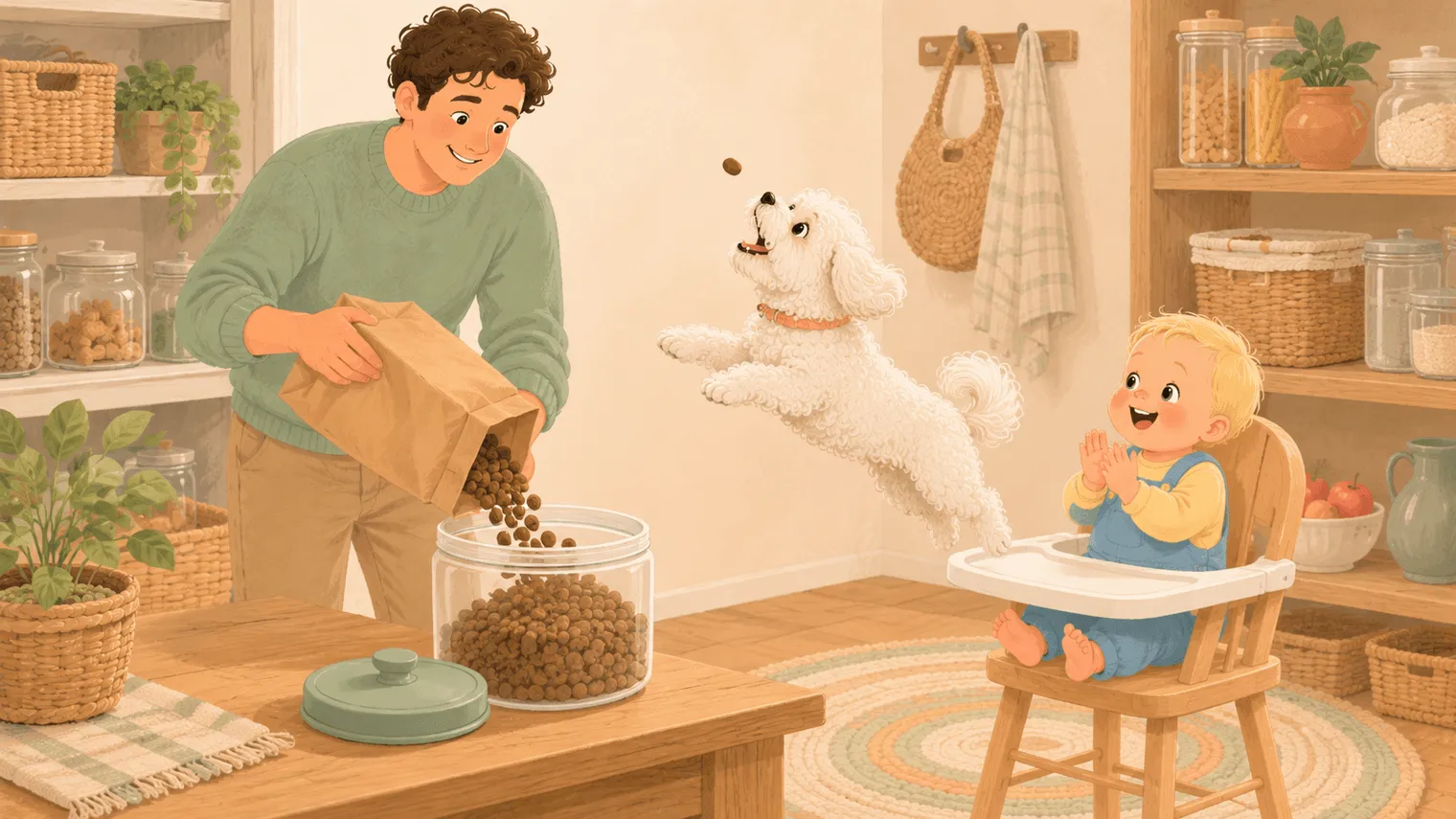
The dog side is freshness. An opened kibble bag is a slow-motion staleness machine — the fats oxidize and smells fade once air gets in, and owners often suspect a bout of picky eating is really a freshness complaint. The Vault’s gasket lid is designed to be airtight per the listing; the most common owner observation after switching is a dog suddenly more interested in the same old food.
The baby side is access. Kibble is the small, hard, round shape that pediatric choking guidance warns about, and dog-food bowls and bags sit at floor level — crawler altitude. A screw-top vault turns “constantly police the pantry” into “solved at purchase.” (The bowl itself still needs the feeding-time routine once the baby’s mobile — gate the dog’s dining room or lift bowls between meals.)
What owners say it’s like to live with
The screw lid is the personality of the product: three seconds, two hands, every time. Owners who scoop twice a day report it becomes muscle memory; owners who wanted one-handed flip-top convenience say they knew the trade and took the flip-top — and their toddlers learned to open it, which is the whole story in one sentence.
Two practical notes recur in long-term reviews: wash and dry it fully between refills (owners mention kibble dust plus time builds a film), and if you go bag-in-vault, keep the bag’s lot number visible — it’s your recall insurance.
 The plastic itself has a reputation in owner reviews for surviving garages,
road trips, and being stood on by children.
The plastic itself has a reputation in owner reviews for surviving garages,
road trips, and being stood on by children.
Who should buy it — and who shouldn’t
Buy it if your dog food currently lives in its bag, your baby has located the pantry, or your dog has ever self-served. Owners treat it as cheap insurance on both fronts.
Skip it if you need one-handed scooping above all (accept a toddler-openable flip-top and move the container up high), or your kibble arrives in quantities a small bin can’t justify.
Put plainly
If you want a container that a toddler can’t open and a dog can’t crack, and you’ll accept a two-hand, three-second lid in exchange, owners are overwhelmingly glad they bought it. If you wanted one-handed flip-top convenience above all, this isn’t that — and the convenient version is exactly the one toddlers learn to open. That trade-off is the entire story.
At a glance
Gamma2 Vittles Vault
What stands out
- Screw-on lid with a gasket — designed to defeat toddler hands and clever noses, and owners describe it as airtight
- Owners keep reporting kibble that stays fresh to the bottom of the barrel
- Food-grade plastic per the listing, with a long-standing owner reputation for taking abuse
Things to know
- The screw lid takes two hands and three seconds — the price of being hard to crack
- Owners with the big sizes mention the footprint; measure the pantry corner first
Questions families actually ask
Why not just keep kibble in the bag with a clip?
Two reasons, one per species. Freshness: the fats in kibble oxidize once air gets in, which is why pet-food guidance leans toward sealed storage — and owners switching to a sealed container consistently report dogs more enthusiastic about the same food. Safety: a bag with a clip is zero-proof against a crawler who finds the pantry — small, hard, round pieces are the kind of thing pediatric guidance flags as a [choking hazard](https://www.healthychildren.org/English/health-issues/injuries-emergencies/Pages/Choking-Prevention.aspx), and a baby-proof container removes the whole question.
Should I pour kibble in, or keep it in the original bag inside the container?
Bag-in-container is the answer the [FDA's storage guidance](https://www.fda.gov/animal-veterinary/animal-health-literacy/proper-storage-pet-food-treats) points to: it says to put the whole bag in the container rather than pour the kibble loose, so you keep the lot number and 'best by' date in case of a recall. Pouring directly is fine too if you wash and fully dry the container between bags — the same guidance suggests that between refills, and owners do both happily. Either way beats the clip.
Can a determined dog open it?
Owner reviews are remarkably consistent: counter-surfers knock it over, nose it around the floor, and get nowhere — the screw threads defeat paws and jaws. The weakness owners flag is human error: a lid threaded lazily crooked is not sealed. Two seconds of attention solves it.
What size fits what dog?
Rough kibble math: the 15 lb vault fits a small-dog month, the 35 lb handles a typical large bag, and the stackable 40+ lb sizes suit multi-dog homes. Buy the size matching the bag you actually purchase — owners note kibble stays freshest in a container it nearly fills.