Tractive GPS Dog Tracker: A Plain Guide for Dog-and-Baby Homes
Reader-supported — if you buy through our links we may earn a commission, at no extra cost to you. As an Amazon Associate I earn from qualifying purchases. Details

The Tractive GPS Dog Tracker is a small device that clips onto a collar you already own and tells you where your dog is in real time, anywhere it has mobile coverage. It’s built for people who want live location and a virtual fence around the yard — and it tends to earn its keep most in a house where your attention is already split, like one with a new baby in it.
A note on how we put this together: we haven’t strapped one to a dog ourselves. This guide is built from Tractive’s published specs and the very consistent patterns across hundreds of owner reviews. Where the spec sheet and real owners disagree — battery life is the big one — we say so and let you decide.
What it actually does
The tracker connects over a cellular network through its own built-in SIM, which is the important part: that’s why it works far beyond the short range of a Bluetooth tag, and also why it needs a subscription (more on that below). Live tracking refreshes every few seconds, so on the map you see the dog moving rather than a stale last-known dot.
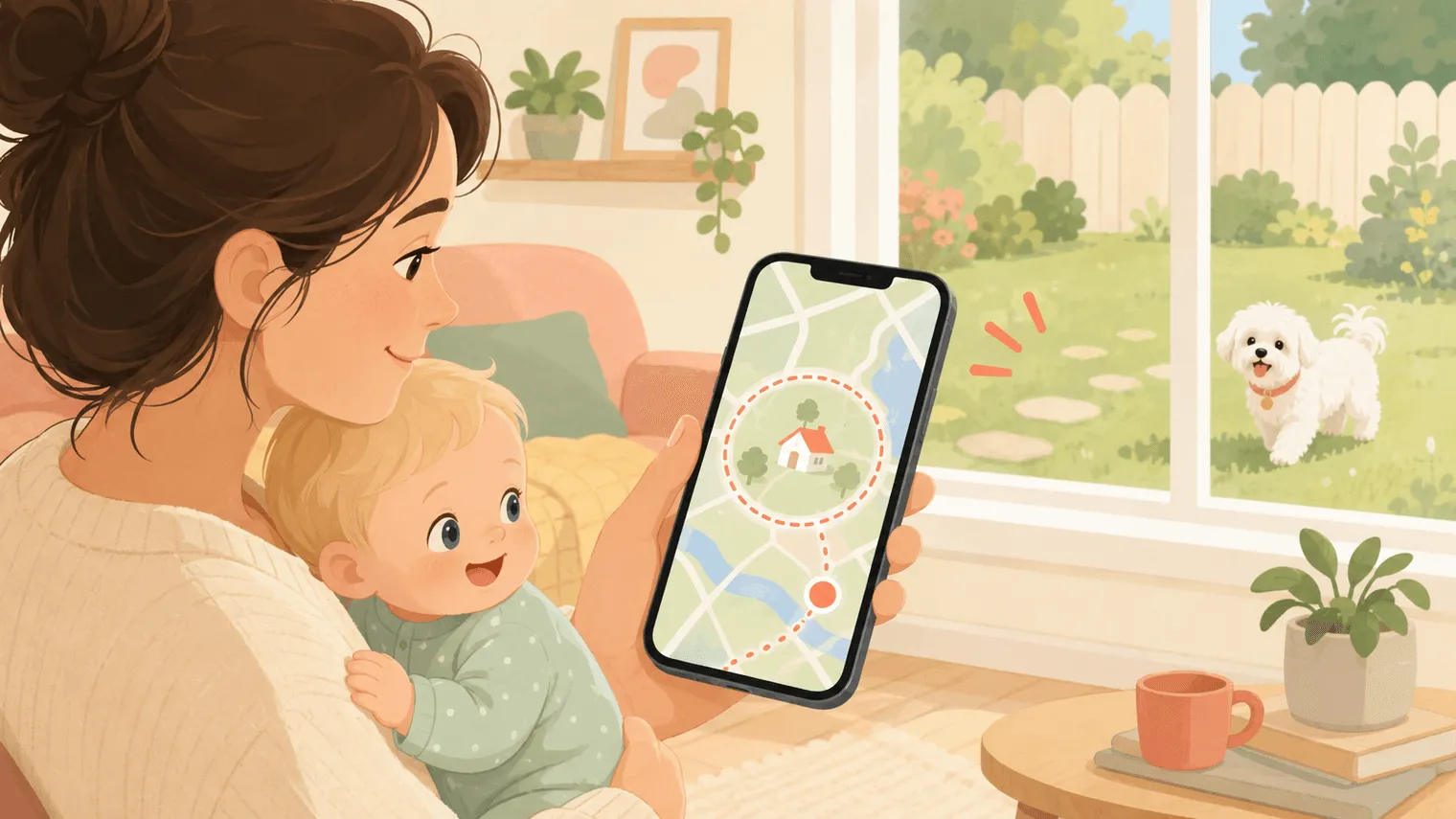
The feature most owners actually rely on is the virtual fence. You draw a boundary on a map — your yard, the dog park, grandma’s place — and the app buzzes your phone the moment your dog crosses it. The tracker is IP68 waterproof, so a puddle or a bath won’t kill it, and the newer models add activity, sleep, and vital-sign monitoring on top of the location features.
Why a dog-and-baby home is the use case
Plenty of people buy a GPS tracker “just in case.” The case gets a lot more concrete the first time you’re carrying a car seat in one hand and a diaper bag in the other, and the dog slips out the open front door behind you. You can’t put the baby down on the driveway to sprint after the dog, and those are the exact seconds that decide whether this is a non-event or a very bad afternoon.
A tracker that pings your phone the instant the dog leaves the yard turns “I realized at bedtime that the gate was open” into “I knew in ten seconds.” Same story at 2 a.m., when the dog’s in the backyard and you’re pinned to a chair mid-feed — you can glance at the map instead of waking the whole house to do a headcount. None of this trains the dog or replaces a fence; it just buys back the attention a new baby has already spent.
What owners consistently like
Across owner reviews, the praise clusters in three places. The real-time movement is the big one — people describe watching the dot travel down the street and meeting the dog halfway, which a “last seen here” tag can’t do. The unlimited range comes up constantly from anyone whose dog has ever cleared a fence: because it’s cellular, there’s no “out of range,” only “out of coverage.” And the geofence alerts get credited again and again with catching an escape early enough to matter.

Things to know before you buy
Three honest caveats, all straight from owner reports rather than our own bench time:
- The subscription is mandatory. The tracker is a paperweight without a plan, and that’s a recurring cost on top of the roughly $79 hardware. It’s not expensive as these things go, but you should decide you’re fine paying it monthly before the box arrives, not after.
- Battery life is the most common gripe. Tractive’s “up to weeks” figure assumes light use; owners who keep it in live mode regularly report a small fraction of that — sometimes a charge every couple of days. If nightly charging would annoy you, factor that in.
- It leans on coverage, and it’s a bit chunky. Accuracy and update speed track your local cell signal, so dead zones are dead zones. And owners of very small dogs sometimes find the standard unit bulky on the collar — the XL versions are bigger still.
Put plainly: if you want live, go-anywhere location with an escape alarm, and you’ll genuinely keep the subscription going, owners are largely glad they bought it. If what you wanted was a one-time purchase with no monthly fee, this isn’t that — and that’s the single most useful thing to know before you pick one up.
At a glance
Tractive GPS Dog Tracker
What stands out
- Live location that refreshes every few seconds, so you watch the dog move in real time instead of seeing where it was a while ago
- Cellular SIM built in — it works wherever there is mobile coverage, not just near the house like a Bluetooth tag
- A virtual fence that pings your phone the moment the dog crosses the line you drew around the yard
Things to know
- It does nothing without a paid subscription — that is an ongoing cost on top of the tracker
- Owners report the battery lasts far less than the headline figure once you lean on live mode, sometimes a couple of days
- Accuracy depends on cell signal, and the unit is a little bulky for very small dogs
Questions families actually ask
Does the Tractive tracker need a subscription?
Yes — it doesn't work without one. The tracker has its own SIM card and Tractive pays the mobile network for the data, so a plan is required; per Tractive, plans start around $5 a month on a long-term option. Budget for the subscription, not just the one-time hardware price.
How long does the battery really last?
It depends heavily on how you use it. Tractive advertises up to a couple of weeks (and much longer on the XL models for big dogs), but owners who keep it in live-tracking mode consistently report far less — some only a couple of days. Treat the headline number as a best case, not a daily average.
Can I use it to track my baby or as a baby monitor?
No. It's a pet device — designed, certified, and supported for dogs, not children. A baby monitor and a child locator are their own regulated products; use the right tool for each and don't repurpose a dog tracker for a kid.
What size dog is it for?
Tractive recommends the standard tracker for dogs roughly 9 lbs and up, and sells larger-battery XL versions for big breeds. Owners of very small dogs sometimes find it bulky on the collar, so weigh the size against your dog before buying.