Best Robot Vacuums for Dog Hair (That Won't Wake the Baby)
Reader-supported — if you buy through our links we may earn a commission, at no extra cost to you. As an Amazon Associate I earn from qualifying purchases. Details
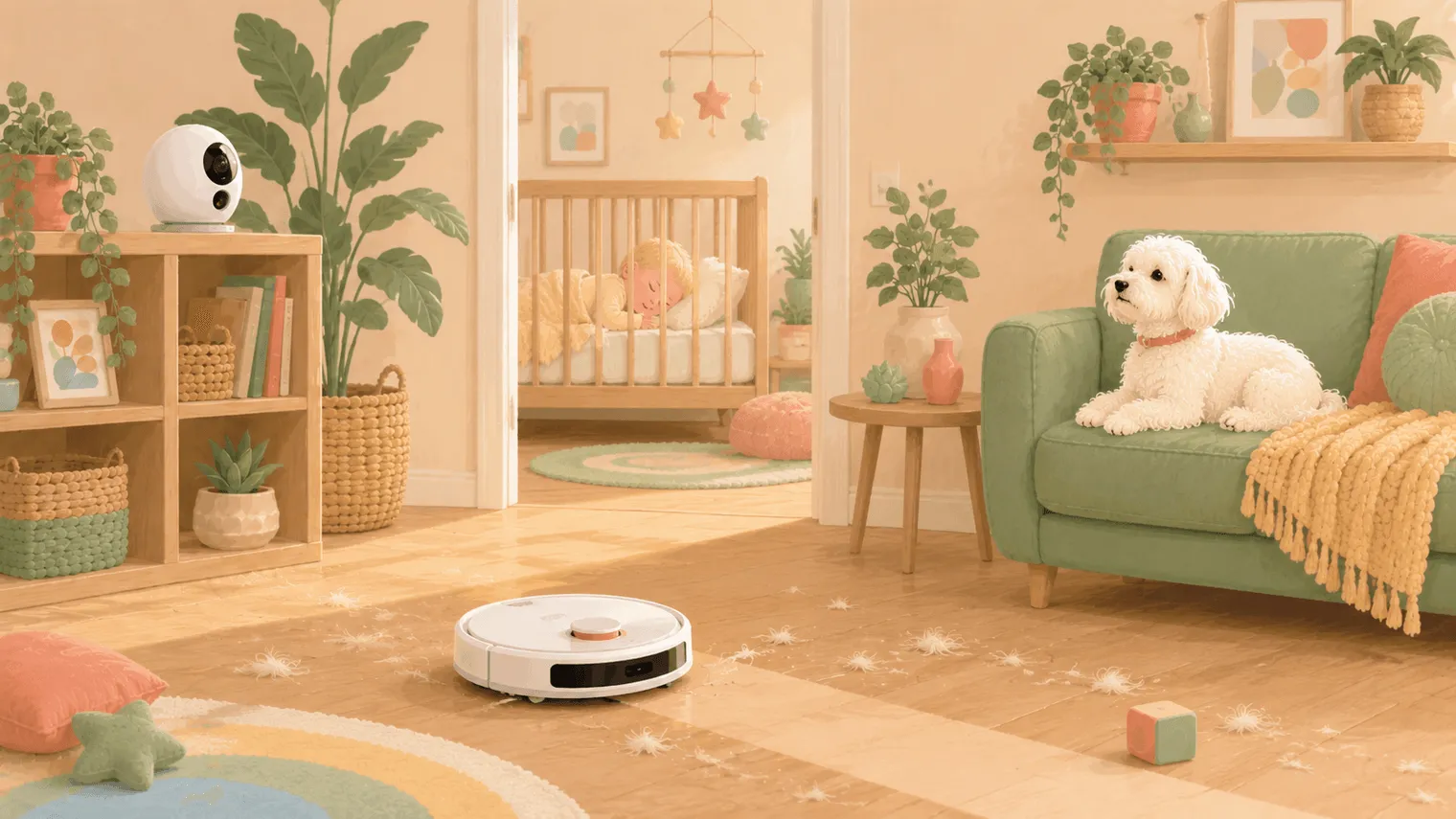
Dog hair plus a crawling baby is a math problem: everything on your floor ends up in a fist, and some of those fists end up in a mouth. A robot vacuum doesn’t replace real vacuuming, but it resets the floor to acceptable every single day without you lifting anything — which, in the first year of parenthood, is the household equivalent of free money.
The short version: the Roborock Q5 Pro+ is the better dog-hair eater for the money and the default pick for most shedding-dog homes. The Roomba j7+ picks up less hair but sees better — and if your household includes a puppy, a senior dog, or anyone with a history of indoor surprises, owners say its poop-dodging camera is worth the premium.
We haven’t tested these ourselves — this comparison is built from the spec sheets, independent lab measurements, and the recurring themes across thousands of owner reviews. Where the spec sheet and owners disagree, we say so.
How we compared them
- Dog-hair pickup. The thing the title promises, leaning on independent testing and owner reports rather than marketing claims.
- Nap-time noise. Cleaning volume, and the often-ignored roar of self-empty docks.
- Obstacle smarts. Toys, cords, and the catastrophic edge case: pet accidents.
- Upkeep & value. Bags, filters, brush maintenance, and what owners say the machine honestly costs to live with.
Where they’re the same
Both are self-emptying robots aimed at busy homes: each runs a scheduled clean, returns to a dock, and offloads its bin into a bag so you’re not emptying a dustbin daily. Both map your home and take app commands. The sameness isn’t the story — what separates them is what they do with their brushes and their eyes.
Dog-hair pickup: the Roborock pulls ahead
In Modern Castle’s pet-hair-by-weight test, the Q5 Pro+ removed roughly 99% of pet hair — well above the ~76% average they’ve recorded across the category — and owner reviews back it up with the most convincing metric there is: people with multiple dogs describing shock at what the dustbin holds. The dual rubber rollers resist the hair-wrap death spiral that owners say kills single-brush machines, and the self-empty dock means the robot handles its own disgusting parts for weeks at a stretch.
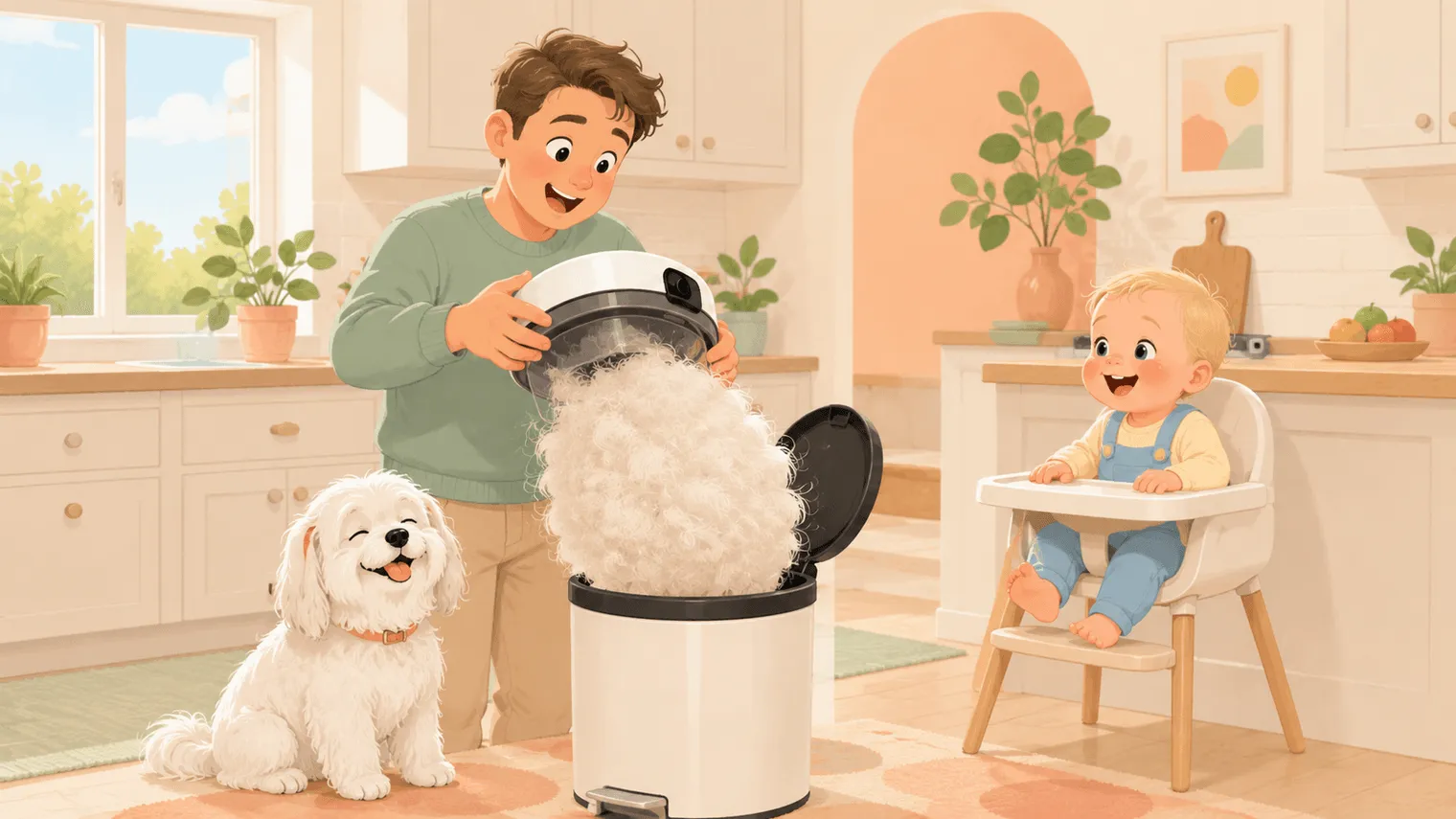
The j7+ is no slouch on hair — these are different labs running different protocols, so read the numbers as two snapshots, not a head-to-head. In Tom’s Guide’s separate test, the j7+ scored about 82.5% on their overall pet-hair pass, and on dog hair specifically picked up 92.5% on hardwood and 72.5% on carpet — solid on hard floors, weaker on rugs. Worth noting: Modern Castle, the same lab that gave the Roborock its 99% figure, rates the j7+‘s own pet-hair pickup as “excellent” and among the top performers it has tested, its dual rubber brushes praised for grabbing long strands without tangling. Owners do report the brushes can gather hair into tidy “hair worms” the suction doesn’t always finish off, a phrase common enough in reviews to be a meme. Both machines handle a shedding household well; for the lowest price per gram of fur, the Roborock is the one owners reach for first.
Obstacle smarts: the Roomba sees what it’s doing
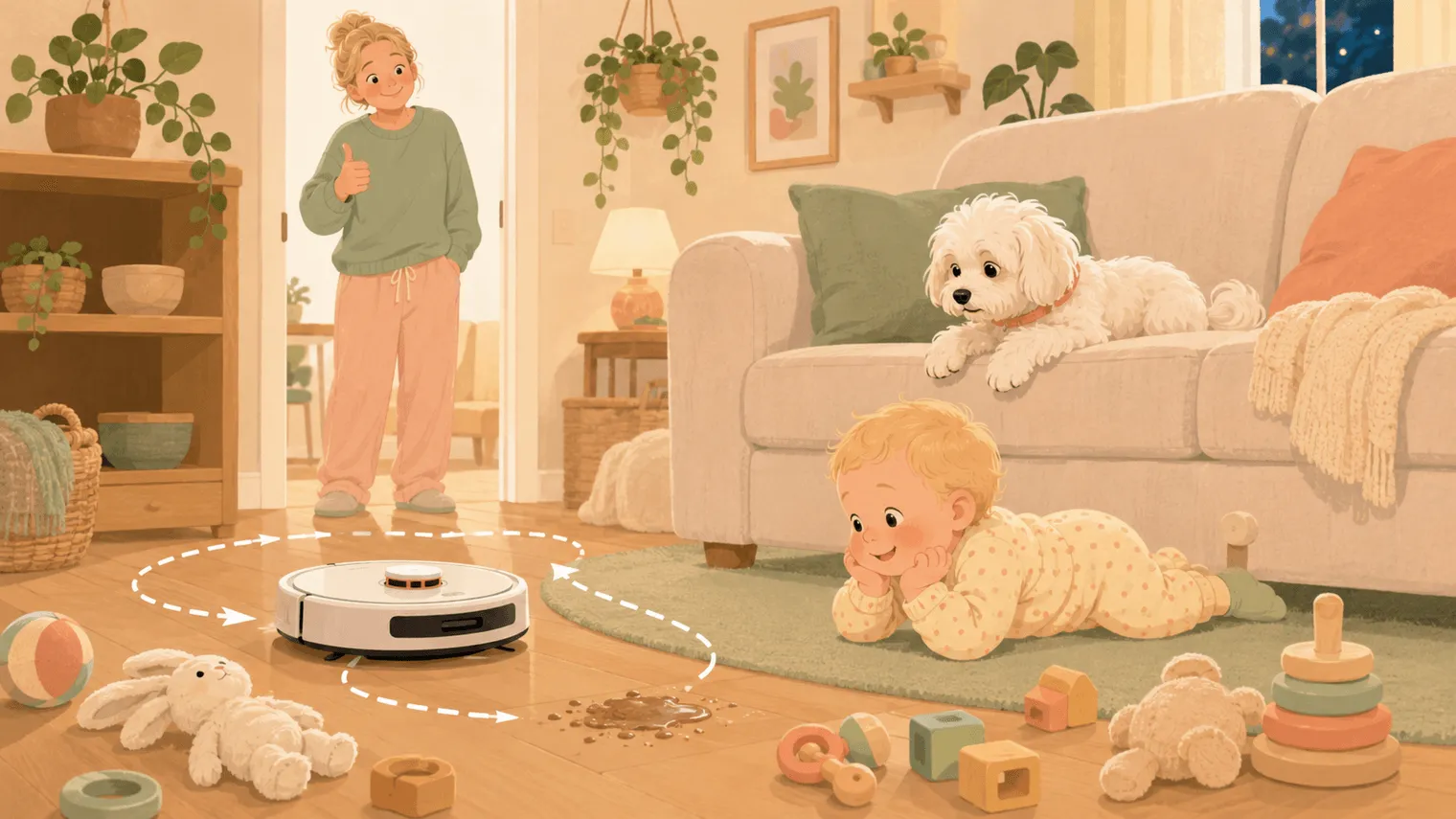
The j7+‘s camera does something owners say is genuinely rare: it identifies obstacles — cords, socks, abandoned baby toys, and yes, pet waste — and goes around them. iRobot is confident enough to back it with the P.O.O.P. promise (genuinely its name): if the robot fails to avoid pet waste, they replace the robot. In a house where a crawling baby shares floor space with a dog of uncertain digestion, owners describe that less as a gimmick and more as insurance.
The Roborock has the honest trade-off here: owners with dark flooring report its cliff sensors occasionally mistaking dark rugs for the void and refusing to cross — a quirk that comes up often enough to call a pattern. And the attached mop pad, per owner reviews, is a damp cloth being dragged around — harmless, but don’t let it factor into the price you’re willing to pay.
Nap-time noise and upkeep
Owners describe the j7+ as running noticeably quieter than most rivals day-to-day, which nap-scheduling parents will appreciate, though its disposable dock bags are an ongoing cost. The Roborock is the louder character in regular cleaning, and during real shedding season owners report its big dock bag filling faster than you might expect. Either way, the loudest ten seconds of the day belong to the self-empty dock on both machines — schedule that for when nobody’s sleeping.
Which fits which home
If your household is mostly a shedding-dog problem — fur on every floor, nobody with a digestive history — owners are glad they bought the Roborock Q5 Pro+, especially at its frequent sale price. If you’ve got a puppy mid-training, a senior dog, or any reason to fear a 6 a.m. accident meeting a crawling baby’s hands, owners say the Roomba j7+ earns its premium on the camera alone. Buy the Roborock for the appetite; buy the Roomba for the eyes.
The nap-time playbook
Whichever robot you pick: schedule runs for awake windows, put the dock as far from the nursery as the floor plan allows (the ten-second self-empty roar is the loudest thing either machine does), and check the brushes weekly during shedding season. Owners report a robot that runs every day at 2 p.m. becomes white noise to both the dog and the baby within a week — novelty, not volume, is what wakes everyone up.
Our picks at a glance
Roborock Q5 Pro+
What stands out
- Dual rubber roller brushes that one independent reviewer credited with near-total pet-hair pickup
- Self-empty dock means weeks between dustbin chores, even in shedding season
- Routinely discounted, which owners cite as the clincher
Things to know
- Owners with dark flooring report the cliff sensors false-triggering on dark rugs and refusing to cross them
- Per owner reviews, treat the mop pad as a bonus, not a feature — it drags rather than scrubs
iRobot Roomba j7+
What stands out
- Camera-based avoidance that owners say actually dodges pet waste, cords, and scattered toys
- iRobot's P.O.O.P. promise: if it hits pet waste anyway, they replace the robot
- Owners describe it as quieter than most — easier to run during daytime naps
Things to know
- Hair pickup is strong on hard floors but weaker on rugs — Tom's Guide measured ~92.5% on hardwood vs ~72.5% on carpet
- Disposable dock bags are an ongoing cost owners flag
Questions families actually ask
Will a robot vacuum wake a sleeping baby?
Usually not, if you schedule it right. Robot vacuums hum along at conversation volume — the loud part is the self-empty dock, which roars like a full-size vacuum for about ten seconds. Schedule cleaning during awake time or far from the nursery, and set the dock to empty when nobody's sleeping.
Is the poop-avoidance thing a gimmick?
Owners with puppies and senior dogs say it's the least gimmicky feature in the category. Ask anyone whose basic robot found an accident at 6 a.m. and redistributed it across forty square meters. If your dog is a puppy, a senior, or has an unreliable stomach, camera-based avoidance is worth real money.
Robot vacuum or cordless stick for dog hair?
Both, ideally — they solve different problems. The robot handles the daily baseline so hair never piles up; a stick vacuum handles stairs, sofas, and the spots the robot can't reach. If you can only buy one and you have a heavy shedder, owners lean toward the robot for consistency.
How often do I really need to empty and clean these?
With a self-empty dock: the bag or bin monthly-ish, but check the brushes weekly during shedding season — long hair wraps any roller eventually, and a wrapped brush quietly stops picking up hair days before you notice.